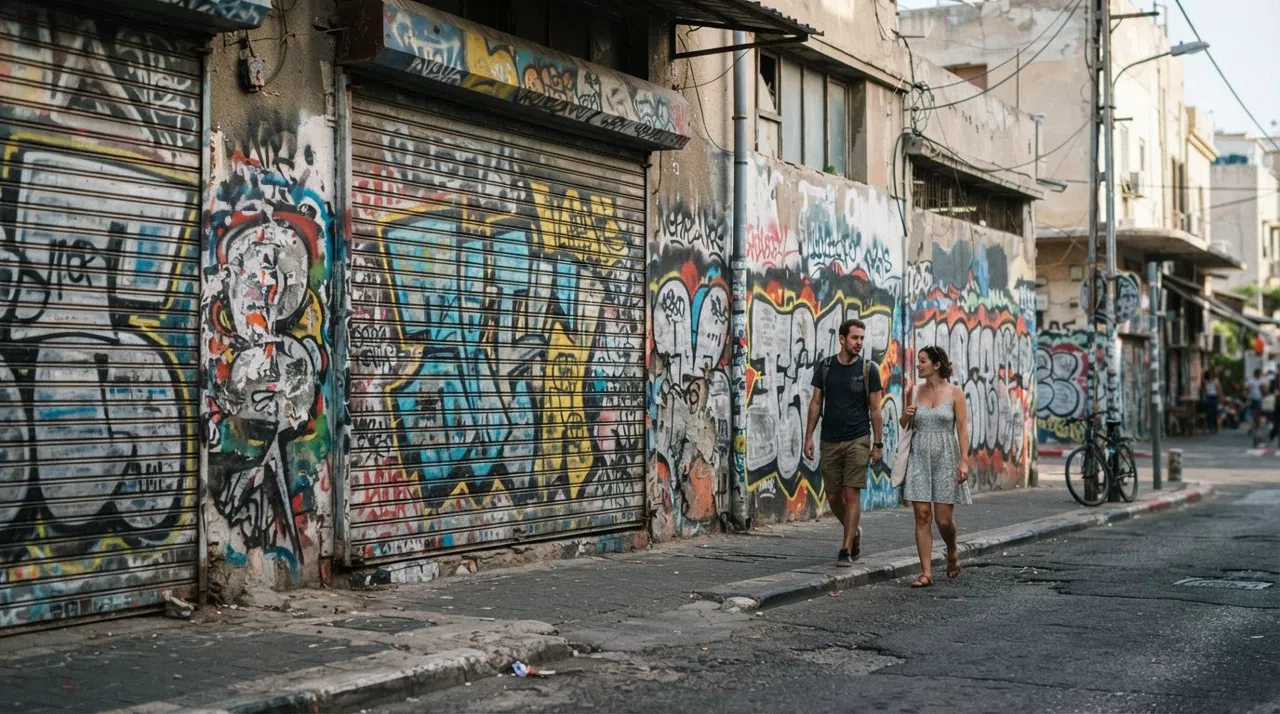
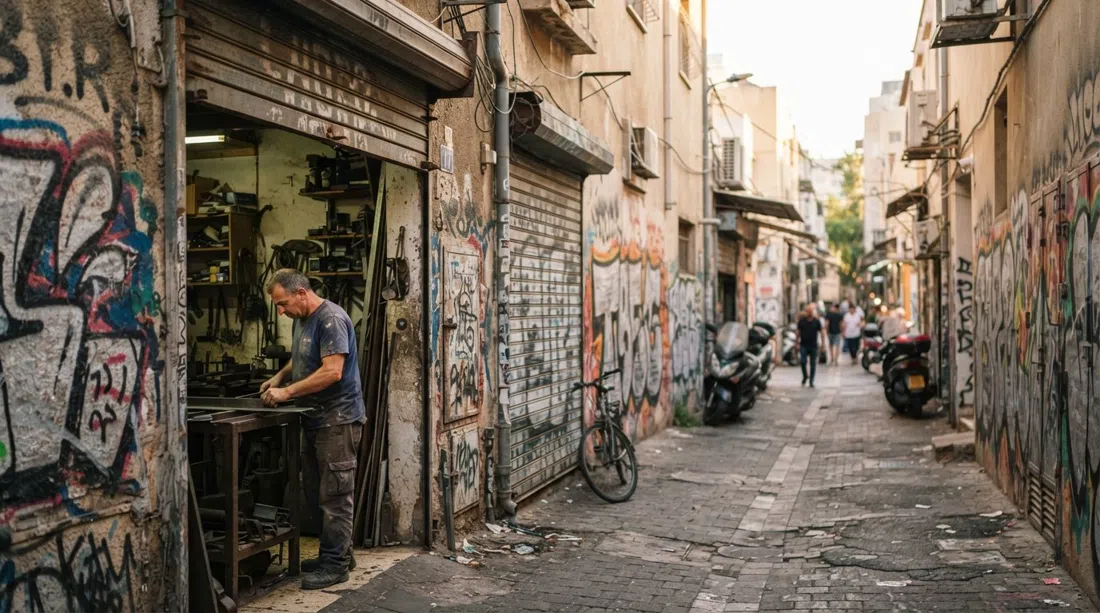
Florentin still feels like a neighbourhood that has not decided whether it is becoming something else or refusing the idea altogether. The clue is in the streets: metal shutters tagged floor to roof, sawdust on the pavement, a truck unloading produce beside a wall mural that may be gone by next season. The land was bought in the 1920s by Salonika Jews who had fled the Thessaloniki fire, and the district kept the low, working skeleton they left behind. That is why Florentin can hold a spice market, a carpentry shop and a bar pouring beer into jam jars on the same block without looking especially surprised by itself. It is Tel Aviv with the polish scraped off, and for a lot of people that is the point.
Walk it in daylight first. Florentin is best understood on foot, with the heat still manageable and the workshops open, when the neighbourhood sounds like what it is: joiners’ shops, upholsterers, metalworkers, radios turned up low, doors rolled wide. Then the wall art starts to make sense not as decoration but as a kind of argument with the street. Dede’s small black-and-white creatures appear on corners and shutters like private jokes made public; other walls carry full-scale murals that arrive, age, and vanish as buildings change hands. The whole district is scruffy on purpose and proud of it, a place people invoke when they want to say “our Kreuzberg” without pretending the comparison is exact. The crowd is young, creative, broke-but-stylish, and there is a strong queer presence threaded through the bars and cafés. Around Levinsky Market the pace changes again, slowing into sacks of dried fruit, cardamom, pickles, and families who have been doing this for generations.
What Florentin is known for
The first thing Florentin gives you is the wall. The best concentration of street art sits in the industrial pocket around Abarbanel, Frenkel, HaMasger and Vital streets, where the shutters of carpenters and metalworkers have become the neighbourhood’s roughest gallery. Dede is the name that comes up most often, and for good reason: the anonymous artist’s stencilled band-aids and little animals have become part of the local visual grammar, joined by work from Know Hope, Klone and a rotating cast of others. Nothing here is fixed. That is the pleasure and the frustration of it. A wall you photograph in the morning may be painted over by the time you come back after dinner, or disappear entirely when a warehouse becomes apartments. Florentin’s art scene is inseparable from its real estate anxiety; both are written on the same surfaces.
The second thing is Levinsky Market, which anchors the southern edge of the neighbourhood and gives Florentin its other pulse. This is not a polished tourist shuk, and it does not try to be. It is a working food street of spice merchants, dried-fruit sellers, pickle stalls and Balkan and Persian delis, with cafés and small restaurants threaded through the old storefronts. By day, the market smells like cardamom, vinegar and roasted coffee. By night, the same streets become part of the neighbourhood’s crawl. That double life — market in daylight, bar district after dark — is Florentin in miniature.
Where to eat & drink
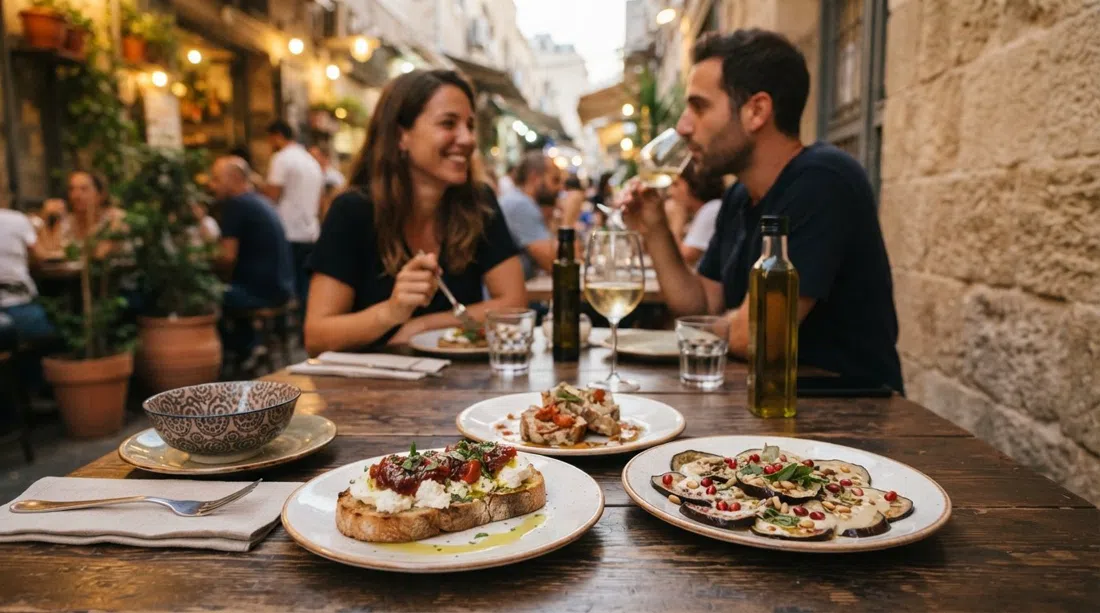
Florentin eats big for a small budget, and the best meals here tend to feel like they were designed for lingering rather than performing. The signature sit-down stop is Ouzeria, on the corner of Matalon and Zevulun, a Greek meze bar under chef Avivit Priel. Order the tulum cheese and cherry-tomato-jam bruschetta, then the eggplant carpaccio, and let the rest of the table fill in around them. It is the kind of place that understands Florentin’s rhythm: casual enough to belong, considered enough to feel like a destination.
For pasta, Tometomato keeps the mood lighter and cheaper, with a daily-changing set of six-or-so handmade shapes at street-food prices, roughly the equivalent of $8-12 a plate. Cacio e pepe one day, sage butter the next: not a grand statement, just the sort of place that makes a neighbourhood feel inhabited by people who actually eat lunch. Bet Romano, in the historic Romano house on Derech Yafo, is the more polished move, with Eyal Shani’s fish-and-vegetables cooking upstairs above Teder. If you are doing Florentin properly, this is one of those combinations that makes sense only in the neighbourhood’s own logic: dinner in a historic house, then drinks in the courtyard below.
For the everyday end of things, Garger HaZahav at Levinsky 30 is the hummus stop that still draws a line of hipsters out front, which is usually the local sign that a place has crossed from good to canonical. The order is simple: hummus, fried cauliflower, homemade falafel. Saluf & Sons does rich Yemenite malawach, jachnun and stews, the sort of food that seems designed to flatten the edges off a long night. Esther & Tony, also known as Tony Ve Esther, is the all-day laptop-and-coffee café with strong vegan options, useful when you need to work through the afternoon before the bars start opening properly.
Cafe Levinsky 41 is one of the market’s small pleasures: a hole-in-the-wall with a repurposed truck out front pouring bespoke gazoz, sparkling water built to order from house fruit-and-herb syrups. It is the sort of detail that makes Levinsky feel less like a market than a living pantry. And then there is Cassata by Park HaMesila, Eyal Shani’s gelato shop, where the flavour list reads like a dare to be specific: tahini-and-fig, olive-oil-and-sea-salt.
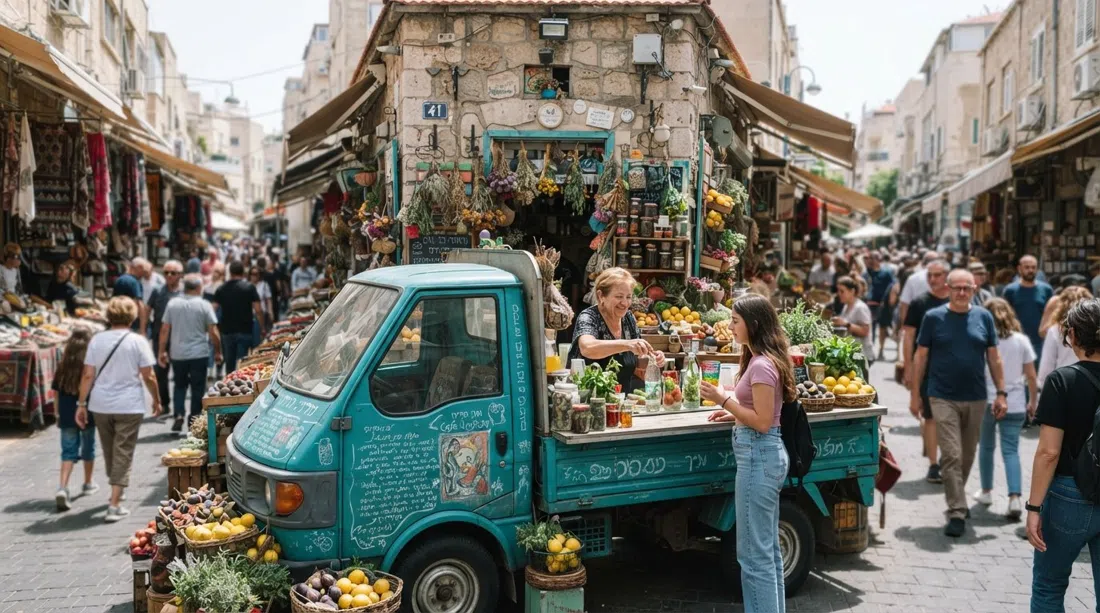
One place to plan around is Burek, Barak Yehezkeli’s no-menu open-kitchen counter. It opens to the public only one night a week, on Wednesdays, and it fills fast. That scarcity is part of the appeal, but it also fits Florentin’s temperament: things here are often a little improvised, a little temporary, and gone if you wait too long.
Going out
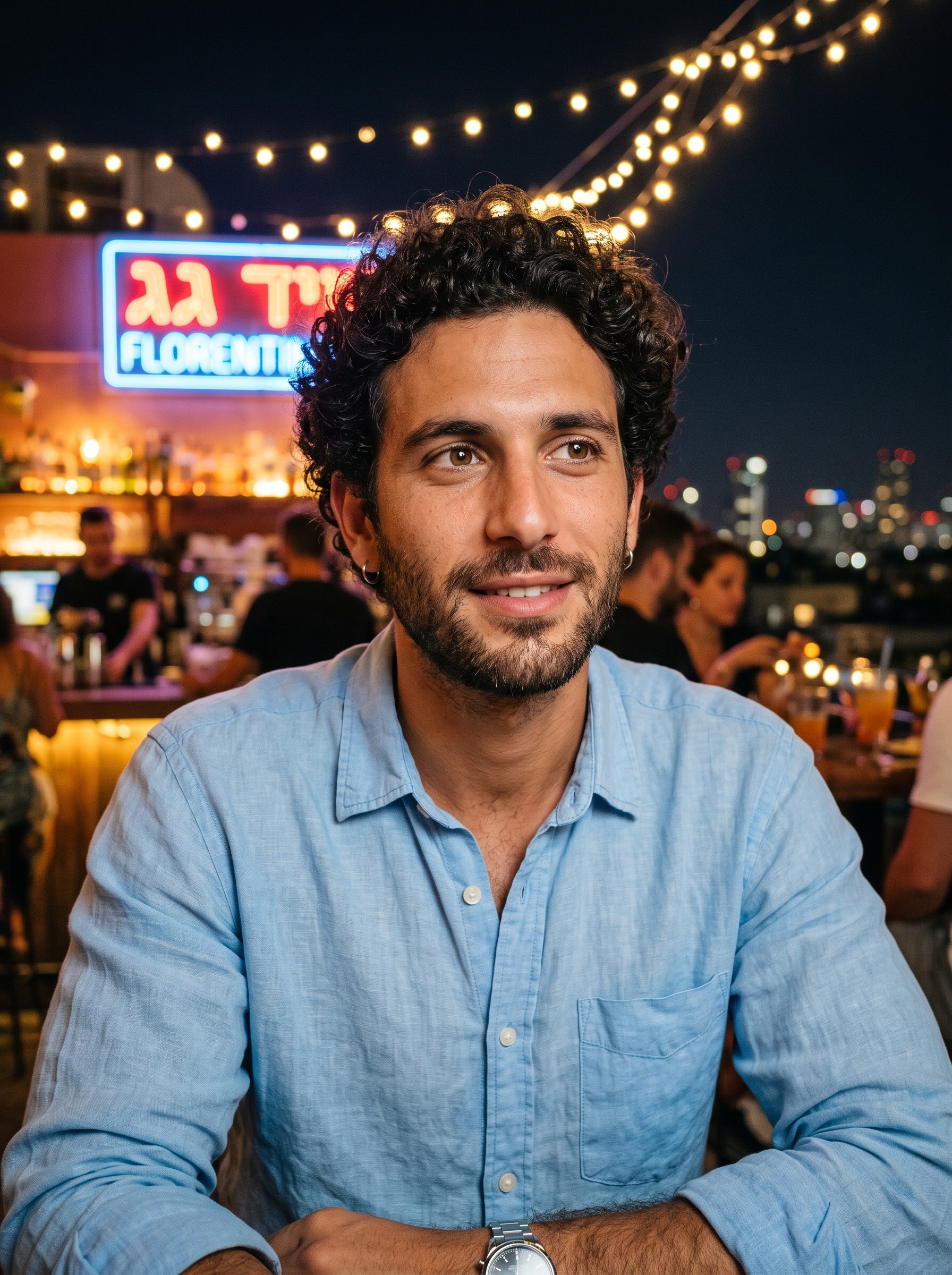
Florentin’s best-value night out is not a single bar; it is a route. The anchor is Teder.fm, the courtyard bar and internet-radio station in the Romano house on Derech Yafo, where beer is poured into jars, pizza comes from the wood fire, and the programming can swing from guest DJs to live sets to film nights under the open sky. It is one of those places that manages to feel both informal and central to the neighbourhood’s identity. If you want the classic version of the evening, pair it with dinner upstairs at Bet Romano and then drift back down into the courtyard once the tables start filling.
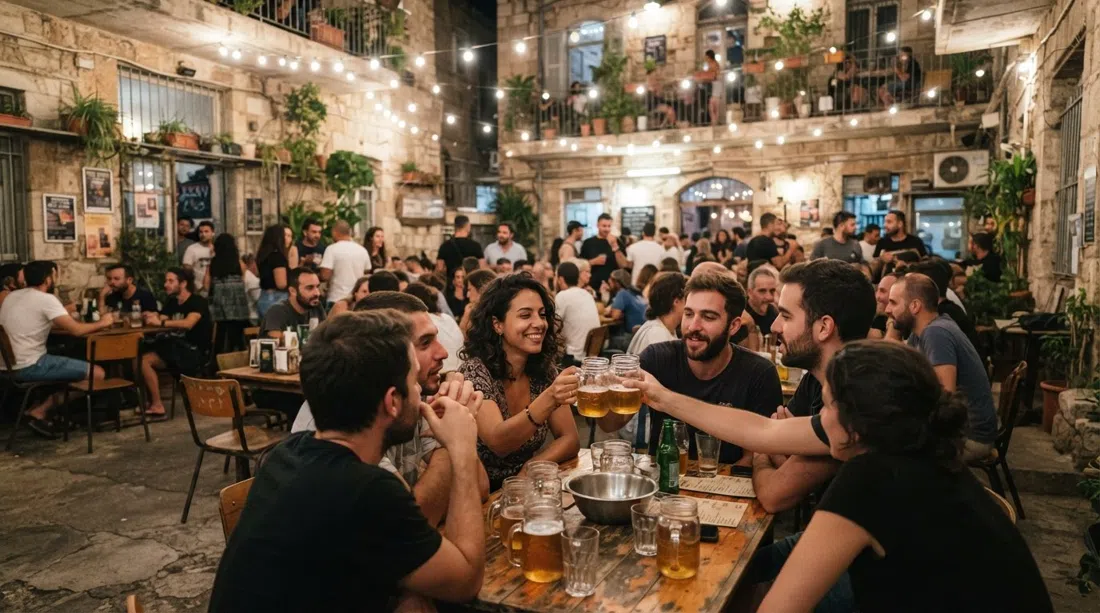
A short walk away, Hoodna brings a different energy. By day it is a workshop; after dark it drags the sofas into the street and turns into a free live-music room with no interest in making the evening more complicated than it needs to be. The bookings run from afrobeat to funk to rock, and the street seating gives it the feeling of a block party that decided to stay put.
The rest of the crawl is dense, walkable, and mercifully unpretentious. Tsuzamen is the dive bar for cheap beer, peeling gig posters, nightly local rock, indie and punk bands, and a pizza that punches above the room. Satchmo, on Chaim Vital Street, calls itself the oldest bar in Florentin, and it behaves like it: whisky-led, regulars-heavy, with a backyard and a rock-and-oldies soundtrack that seems to have no interest in changing for your convenience. Shuffle Bar at Florentin 19 is the softer landing, all local beer on tap and a wall of board games. Mezcal handles the tequila, mezcal and tacos end of the evening. Beer Bazaar, at its Levinsky Market branch, turns the idea of a beer stop into a small expedition with more than 100 Israeli craft labels.
By the time the workshops are shut and the tables have spilled into the road, Florentin feels less like a neighbourhood than a long, loud, cheap crawl. It is grungy, friendly and refreshingly free of velvet ropes. The night does not so much begin here as continue.
Things to do / what to see
The main thing to do in Florentin is walk until the district starts revealing its layers. Give yourself a couple of unhurried hours and make a loop through Frenkel, Abarbanel, HaMasger, Vital and the smaller side lanes off Florentin Street. Start with the industrial streets while the workshops are open, then drift into the alleys where the best pieces hide. The graffiti is almost always better down the side streets than on the main drag, and that is part of the charm: Florentin rewards wandering more than planning.
Guided street-art walks run regularly if you want the politics and the artists’ names rather than just the photos. If you are content to read the city in fragments, you can do it alone, but there is something useful about hearing how the walls change hands along with the buildings they are painted on.
Levinsky Market is the other half of a good day here. Browse the spice and dried-fruit stalls, taste your way through the delis, then break for a gazoz at Cafe Levinsky 41. The market is not large, but it has the density of a place that still serves locals first. It is also one of the clearest windows into the older Florentin, the one that existed before the bars and the murals became shorthand.
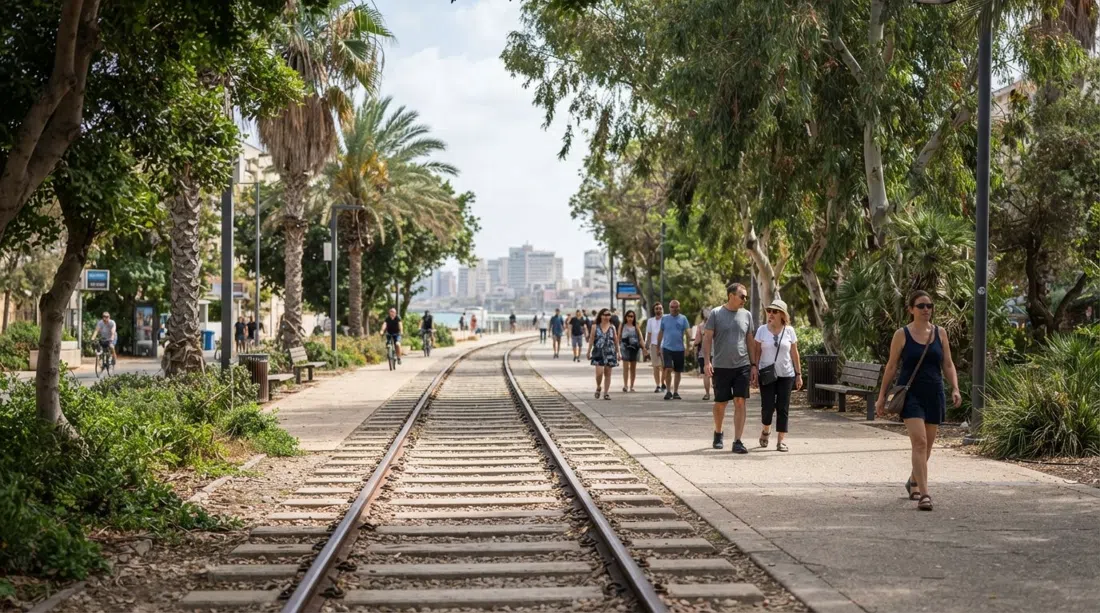
Just south, Park HaMesila runs along a disused Ottoman-era railway, a long green promenade linking Neve Tzedek down through the Florentin edge toward Jaffa. It is one of the neighbourhood’s quietest pleasures: shaded, linear, easy for a walk or run, and useful when you want to move from the clutter of the streets to something more open without leaving the area entirely. Florentin sits directly north of Jaffa, which means you can keep walking and let the day stretch into the flea market and beyond.
Shopping & markets
Shopping in Florentin is less mall, more forage. Levinsky Market is the obvious place to start, and it doubles as one of the city’s best edible souvenir runs. Spice blends like za’atar, baharat and sumac are the obvious takeaways, along with tea, dried fruit and nuts from the long-standing merchants along Levinsky Street. The beauty of buying here is that it is practical before it is performative; you are not shopping for a story so much as carrying home something you will actually use.
Outside the market, the neighbourhood still shows its working past. Carpentry, upholstery, hardware and fabric shops remain in the mix, even as independent design studios, ceramics and secondhand and vintage stores move into the cheaper units. That mix is what makes the area feel alive rather than themed. You can still stumble out of a deli and into a place cutting wood for a living.
The one thing to remember is that Florentin respects the calendar in a very ordinary, very local way. Many market and family-run shops wind down on Friday afternoon and stay shut through Saturday for Shabbat, then come roaring back at the start of the week. If you arrive on the wrong side of that rhythm, the neighbourhood will still be itself — just quieter, and with more shutters down.
Where to stay in Florentin
Florentin works best as a base if you want to be in the middle of the action rather than looking at it from somewhere more polished. The stock here skews toward hostels, guesthouses and apartment rentals rather than full-service hotels, which suits the budget-minded, independent crowd it draws. If you want to be near the nightlife, book around Florentin, Vital or Abarbanel streets, but do so with your eyes open: the bar streets are genuinely loud, and a room directly above them is a bargain only until midnight.
For a softer landing, the northern edge shades quickly into Neve Tzedek and then, a little farther, the Rothschild Boulevard hotel cluster, both an easy 5-15 minute walk away. That gives you a calmer bed without losing Florentin’s late-night edge. It is worth being honest about the trade-off: this is not the place for luxury hotels, and it is not the place for people who want to fall out of bed onto the beach. The sea is a 20-25 minute walk away, which is perfectly manageable if you know it, less charming if you were expecting a shoreline neighbourhood.
Getting around
Florentin is small, flat and made for walking. Most of what you come for sits within a 15-minute stroll, and the neighbourhood’s best moments happen between destinations anyway. It is roughly a 5-15 minute walk north to Rothschild Boulevard and Neve Tzedek, and about 20-25 minutes west to the Mediterranean. Head south and you can walk straight into Jaffa. That geography is one of the reasons Florentin feels so easy to use: it is not isolated, just slightly rough around the edges.
The neighbourhood is not on the light rail’s core stops, but buses run along its edges on Herzl, Eilat and Salame/Shalma roads. Shared e-scooters and bikes are everywhere. If you are heading to the airport, Ben Gurion is about 15 km southeast; the simplest route is to walk or take a short ride to HaHagana station and catch the train, which takes roughly 12-15 minutes to the airport. It is cheap and frequent, though trains and most buses pause for Shabbat from Friday afternoon to Saturday evening, when a taxi or ride-hail becomes the fallback.
Florentin is at its best when you stop trying to optimise it. Let the murals pull you down a side street, let Levinsky slow you down, then let the bars take over once the sun drops. The neighbourhood does not curate itself for you. It just keeps going, and that is why people stay.